MDF or solid wood mouldings: which to choose, and when?
By Rédaction · 27 October 2026 · 6 min read
MDF costs less and takes paint well. Solid wood, for its part, can be carved, varnished and repaired. How do you choose? It all depends on the piece, the finish and the use.
Key takeaways
- MDF suits plain, painted profiles fitted in a dry room, away from knocks.
- For a carved moulding, a clear finish or an addition to existing panelling, solid wood is the choice.
- In busy areas, solid wood is easier to repair after a knock.
- In the specification, write ‘solid wood’ and the species, because ‘wood moulding’ is not enough.
Put an MDF moulding and a solid wood moulding side by side, paint them both white, and you would be hard pressed to tell them apart. At first, at least. The two materials do not react in the same way to damp, to knocks, or to the passing years.
So which should you choose? The answer has less to do with ranking the materials than with three simple questions. Will the moulding be painted? Carved? Exposed to knocks?
MDF mouldings and solid wood mouldings, two very different materials
MDF, short for medium-density fibreboard, is made from wood fibres bound with an adhesive, then pressed. The result is entirely uniform, with no grain, no knots and no figure. MDF mouldings are profiled from this board and often sold primed or pre-painted, in long lengths.
Solid wood, on the other hand, is sawn from the trunk. It keeps its grain, its figure and its individual features. Above all, it lives. It takes in and gives back moisture from the air, which shows as slight movement. That is also what allows it to be carved deeply, sanded and reworked over the years.
What MDF does well
Let us be fair to MDF. It costs less and comes in long lengths, which are handy for long runs. Its regular surface, free of knots and figure, takes an opaque paint well. And in a dry, heated room, it stays stable.
For a plain, painted profile, fitted in a dry room and out of reach of knocks (a wall frame on the upper wall, for example), MDF is a perfectly sensible choice.
Where MDF reaches its limits
MDF dislikes water. In its standard form, it swells on contact with moisture, especially at its cut edges. Moisture-resistant MDF exists, but a bathroom or an exposed entrance calls for real care.
Then come knocks. An MDF edge dents more easily than solid wood and is harder to repair. It is made good with filler.
Relief, too. MDF takes a regular profile well, but its core is less dense than its faces. Fine edges and deep relief are therefore more fragile.
Finally, with no figure, MDF cannot be varnished to show the wood. It is painted, or veneered.
In a building open to the public, a hotel room or a nursery, two further points are checked, whatever the material. First, the reaction-to-fire classification required at that location. Second, the indoor air emissions of the material and of its finish.
What solid wood brings
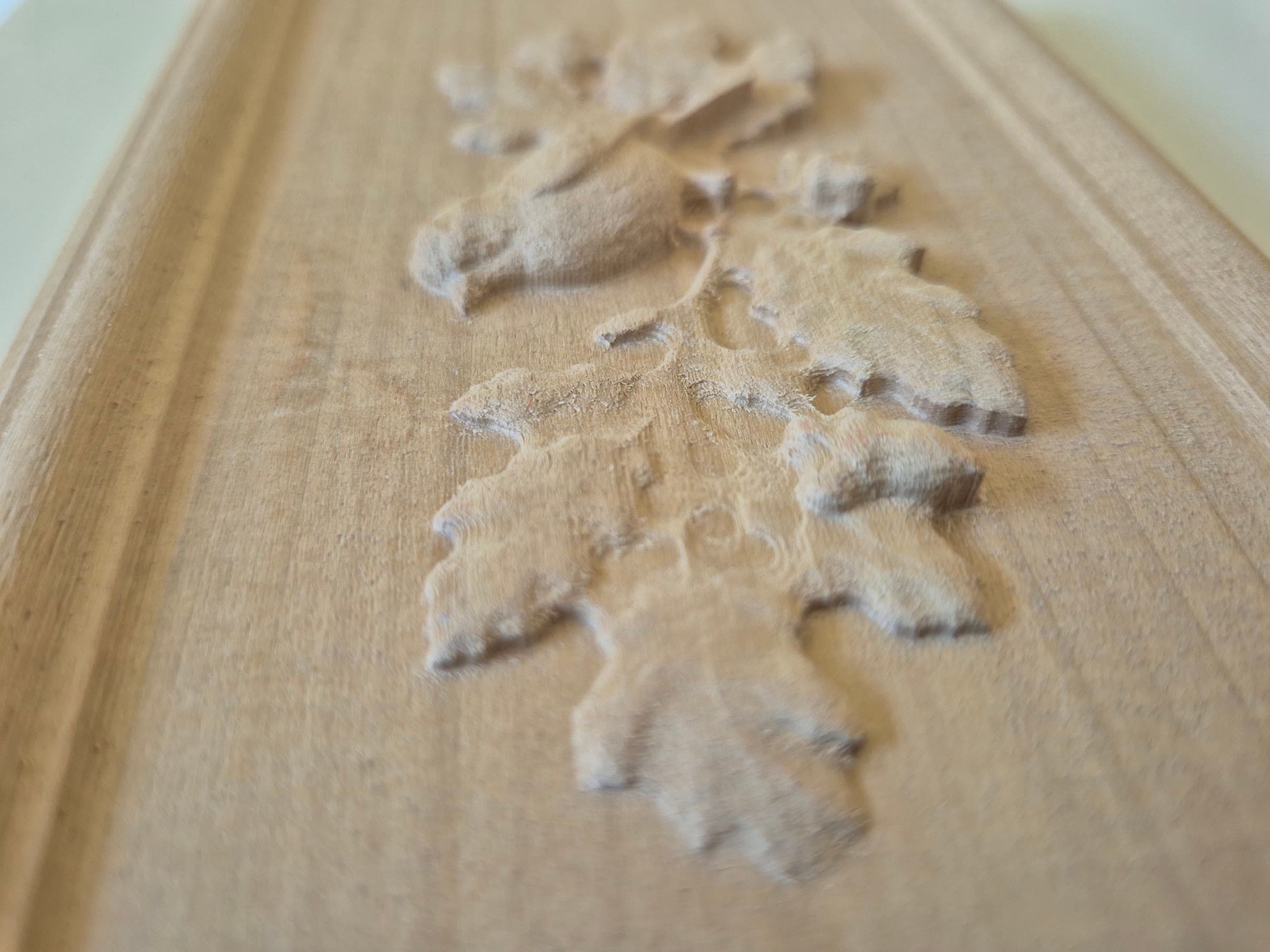
First, carving. Greek keys, scrolling foliage, leafwork, birds… An ornamented moulding is carved from the solid.
Next, freedom of finish. Unfinished, varnished, stained, waxed, painted or gilded, depending on the piece. Under a varnish, the figure of oak or walnut can stay visible and become part of the decoration.
There is also repair. A marked edge can be sanded, filled with the same species, then refinished. A solid moulding can be repainted several times without losing its design, as long as the relief is not clogged.
And then there is harmony with old work. To extend period panelling, a new solid wood moulding with the same profile, and if possible in the same species, matches the existing work. Better still, it ages with it.
In return, solid wood asks for a little care. Let it acclimatise in the room before fitting, plan the joints between lengths, and accept, under a clear finish, the natural variations from one piece to another.
Which species for a solid wood moulding?
It all depends on the finish. A painted moulding is well suited to a pale, even species such as poplar, which carves finely. A varnished, stained or waxed moulding, on the other hand, shows off oak, chestnut or walnut, whose figure becomes part of the decoration.
Our article on choosing the wood for a decorative moulding presents the species one by one. The workshop's customisable dado rail comes in several species, including poplar, oak and walnut, with the finish and length of your choice.
Which to choose? A simple guide
- A plain, painted profile, in a dry room, on a tight budget? Both materials work, and MDF costs less.
- A plain profile in a busy area, such as a corridor, an entrance, a dado rail or a skirting? Go for solid wood, which is easier to repair after a knock.
- A carved or ornamented moulding? Solid wood, without hesitation.
- A varnished, stained or waxed finish? Solid wood again, in a species whose figure you like.
- An addition to existing wooden panelling? Solid wood, with the same profile.
- A damp room? Neither without precautions, and standard MDF is to be ruled out.
Writing the specification clause
A good specification line leaves no room for doubt. It states the material, the species, the profile and the finish. Here is an example.
‘Supply of solid wood dado rail, poplar, profile as per the attached dimensioned drawing, height and projection stated, unfinished and sanded ready to paint, fitted by the joinery contractor according to the approved setting out.’
If you accept an alternative, say on which criteria you will judge it, for example the material, the profile, resistance to knocks and the finish.
Working with the workshop
At AC Boiseries, all our wood is solid French timber from the South-West. Our mouldings, dado rails and panels are modelled in 3D, then carved from the solid in Cornebarrieu, near Toulouse. Each piece is then finished by hand, for the chisel detailing, sanding, patina and finishes.
Pieces leave ready to fit. Fitting is carried out by the professional of your choice, your joiner or your fitter. The workshop can liaise with them and provide the information they need. On request, it also prepares the setting out of lengths and corners for dado rails.
The trade account is for architects, interior designers, joiners and fitters. It gives you conditions specific to your account and a contact at the workshop. And to confirm the species and finish with your client, the workshop sends samples on request.
A boiserie to imagine?
The workshop can turn an inspiration, an archive or an existing décor into a bespoke piece.
Discuss the project