The Classical Orders of Architecture: Symbolism, History and Their Legacy in Woodwork
By Rédaction · 19 October 2026 · 5 min read
Doric, Ionic, Corinthian, Tuscan and Composite: what columns say, from Greek temples to carved wood panelling.
Look up at a church, an old bank, a courthouse or an eighteenth-century panelled drawing room, and you will almost always see columns or pilasters. They are not chosen at random.
Since Antiquity, architects have worked with a precise vocabulary, the orders, which sets the shape of a column, its proportions and the ornament that goes with it. Choosing an order is already a way of saying something.
What is an order?
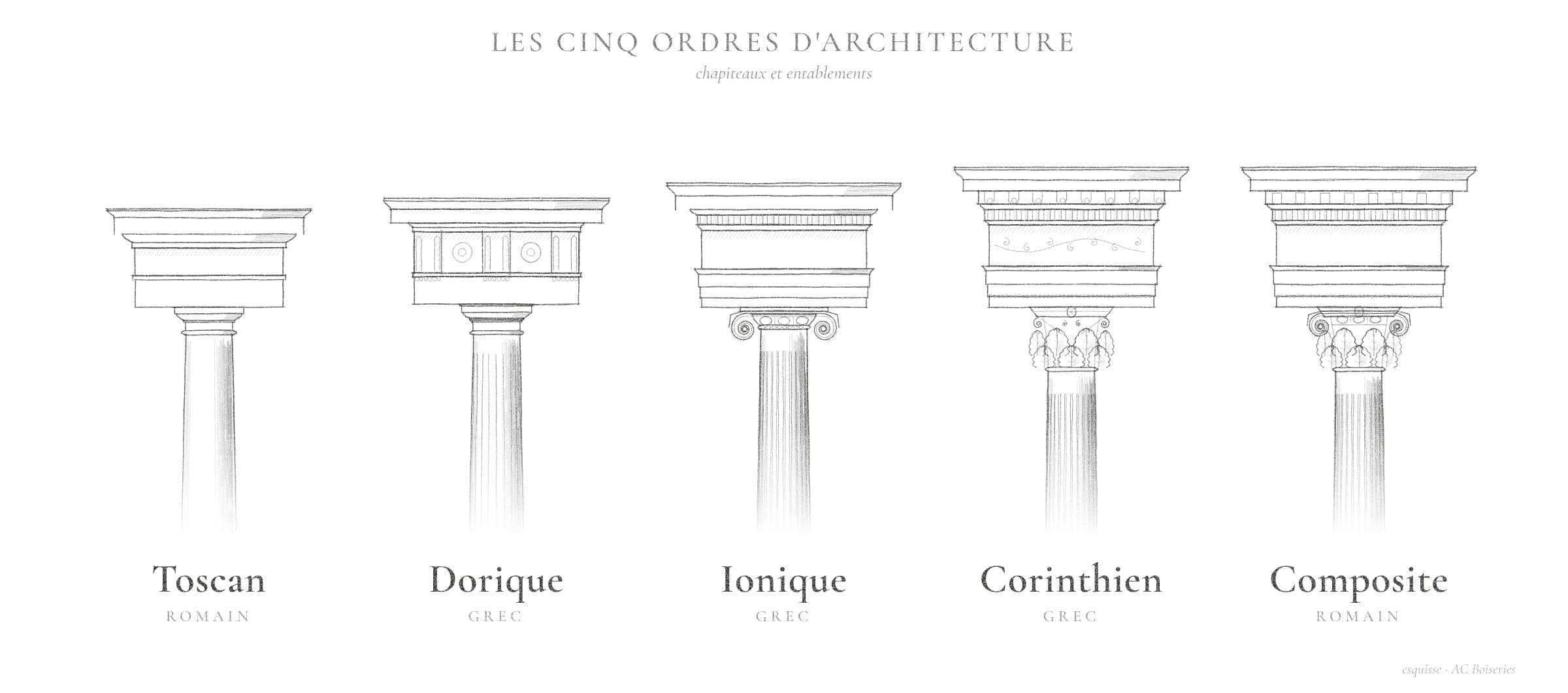
An order is a complete system: a column (base, shaft, capital) supporting an entablature (architrave, frieze, cornice). Everything is governed by proportions expressed in "modules", usually the diameter or half-diameter of the column. The more slender an order, the more refined it is considered.
There are traditionally five. Three are Greek: Doric, Ionic and Corinthian. Two are known as Roman: Tuscan and Composite. Tuscan is the plainest of all, Composite the richest.
The three Greek orders
Doric emerged in the seventh century BC in the Peloponnese, among the Dorians. In Greek buildings the column has no base, the shaft is carved with sharp-edged flutes, and the capital is reduced to a cushion (the echinus) and a square slab (the abacus). The frieze alternates triglyphs and metopes, probably a memory of the wooden beams of early temples. Vitruvius, the Roman architect whose treatise has come down to us, saw in it "the proportion, strength and beauty of a man's body". The Parthenon in Athens and the temples of Paestum are its models.
Ionic appeared in the sixth century BC in Ionia, on the coast of present-day Turkey. It is instantly recognisable by its two spiral volutes. The column, more slender, stands on a moulded base. For Vitruvius it embodied "feminine delicacy", the volutes recalling curls of hair and the flutes the folds of a robe. The Temple of Artemis at Ephesus, one of the Seven Wonders of the World, and the Erechtheion on the Acropolis are Ionic.
Corinthian is the latest of the Greek orders (late fifth century BC). Vitruvius tells the story of its birth: the sculptor Callimachus noticed, on the tomb of a young Corinthian girl, a basket of offerings around which an acanthus plant had grown (read more about the symbolism of the acanthus). Its leaves, curling under the tile that covered the basket, are said to have inspired the capital. The order therefore evokes "the grace of a young girl". The Greeks used it sparingly, as on the Monument of Lysicrates in Athens. It was the Romans who made it their order of prestige: the Pantheon in Rome, the Maison Carrée in Nîmes.
The two Roman orders
Tuscan derives from Etruscan temples. It is Doric simplified to the extreme: a smooth, unfluted shaft, a simple base, a bare capital and a frieze without triglyphs. It is the stoutest and sturdiest of the five.
Composite is, as its name suggests, a blend: the volutes of the Ionic set on top of the double ring of acanthus leaves of the Corinthian. The Romans invented it in the first century AD; the Arch of Titus in Rome (around 81 AD) is one of its first great examples. It is the most sumptuous order, the order of triumph.
These two orders only received their names and their definitive place during the Renaissance. In 1537 the Italian Sebastiano Serlio published the five orders side by side for the first time, from the sturdiest to the most slender; in 1562 Vignola set out their rules in a small handbook that architects, sculptors and joiners would use for three centuries.
A hierarchy, and a language
From then on, the orders form a scale: from the stern, military Tuscan to the triumphal Composite. Serlio even assigned them to particular uses. Tuscan suited fortresses, city gates and prisons. Doric suited churches dedicated to Christ and to warrior saints such as Saint Peter, Saint Paul or Saint George. Ionic suited holy "matrons" and men of learning. Corinthian suited the Virgin Mary and virgin saints.
This hierarchy can also be read vertically. At the Colosseum in Rome, the storeys already stack a Tuscan- or Doric-inspired order at ground level, then Ionic, then Corinthian: the strongest carries the lightest. Renaissance palaces, such as the Palazzo Rucellai in Florence, took up the same principle.
When the order carries a message
Architects have often played with this language.
Athenian democracy and its heirs. The Doric of the Parthenon expresses the power and measure of Athens. In the United States, the Lincoln Memorial (1922) takes up Greek Doric, with thirty-six columns for the thirty-six states of the Union at the time of the President's death.
Glory and power. Napoleon had the Madeleine in Paris built as a "temple to the glory of the Grande Armée", entirely surrounded by Corinthian columns. The façade of the Palais Bourbon, seat of the French National Assembly, answers it from across the Seine with the same order.
Inventing a national order. Louis XIV and his minister Colbert dreamed of a "French order" to rival those of the Ancients. Charles Le Brun designed one for the Hall of Mirrors at Versailles: its capitals combine fleurs-de-lis and Gallic roosters. A century later, the architect Latrobe designed capitals made of ears of corn for the United States Capitol in Washington, as an "American" order.
Reassuring solidity. In the nineteenth century, banks and stock exchanges adorned themselves with Doric or Corinthian columns to signal their seriousness: the Palais Brongniart, the former Paris Stock Exchange, is a fine example.
And where does woodwork come in?
The orders do not belong to stone alone. In the panelling of the seventeenth and eighteenth centuries, joiners and carvers borrowed fluted pilasters, capitals, friezes and cornices to give a drawing room the rhythm of a façade. The mouldings still carved today (egg-and-dart, leaf-and-dart, beading, dentils) come straight from ancient entablatures.
Even the French word cimaise (the dado or picture rail) comes from them: it originally meant the moulding that crowns the cornice of an order, from the Greek kymation, "little wave". Making a cimaise is therefore, often without knowing it, carrying on a vocabulary more than twenty-five centuries old.
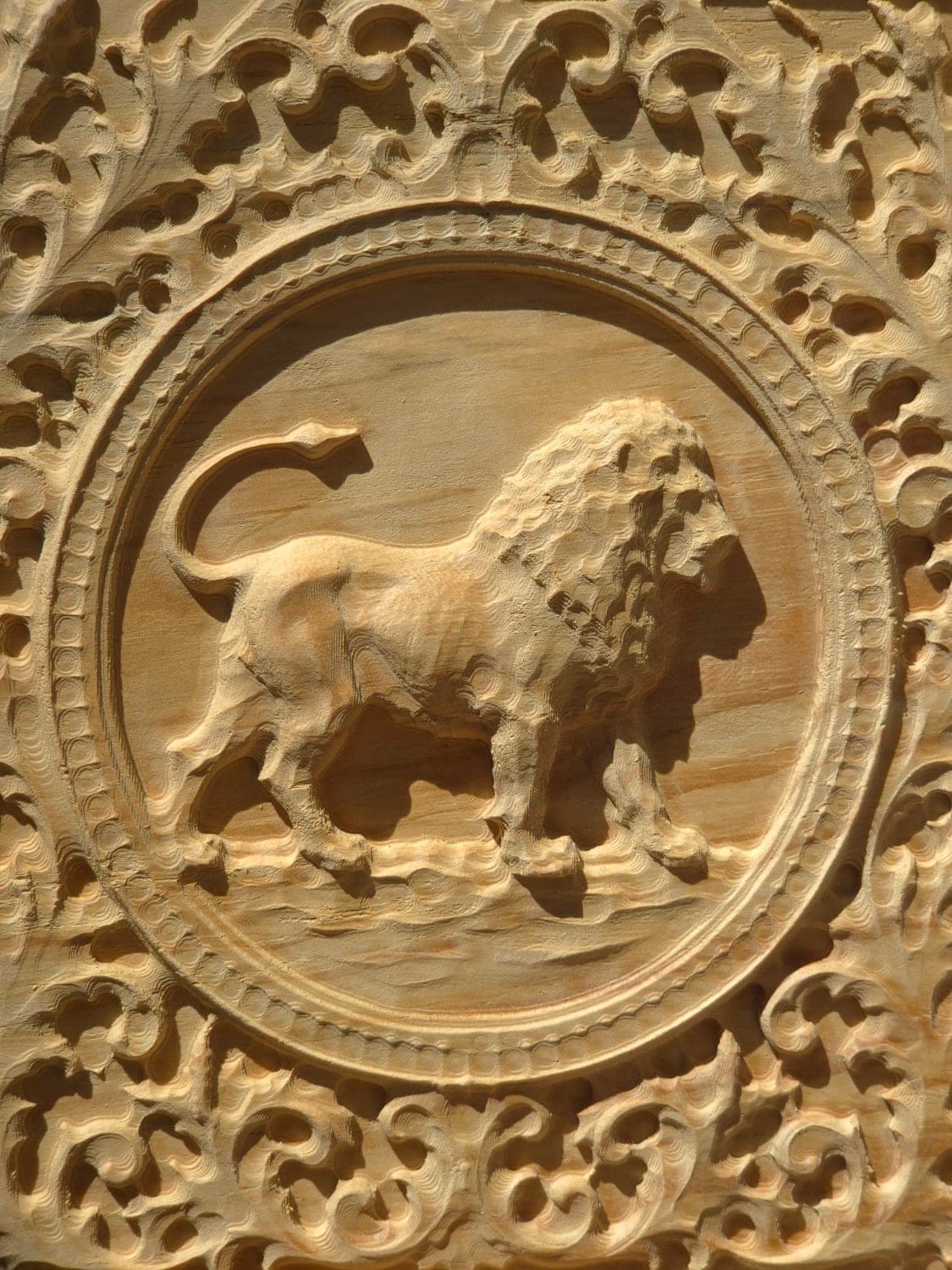
At AC Boiseries, we also make bespoke capitals: modelled in 3D from your design or a survey, then carved from solid wood and finished by hand, they bring this ancient language into your panelling.
A boiserie to imagine?
The workshop can turn an inspiration, an archive or an existing décor into a bespoke piece.
Discuss the project