Design my room in 3DMy room in 3D

Haussmann style

Haussmannian mouldings: recognising, completing and recreating the décor

In a Haussmann-era Paris apartment, the ceiling mouldings are usually plaster or staff, the fibrous plaster of French interiors. Wood is found in the doors, the windows, the parquet floors and sometimes in the panel frames on the lower walls. Telling them apart is the first step to knowing whom to call. Here is how to read this décor, and what a woodwork workshop can bring to it: making a lost wooden piece to match, or giving back the spirit of the Haussmann style to walls that have lost it.

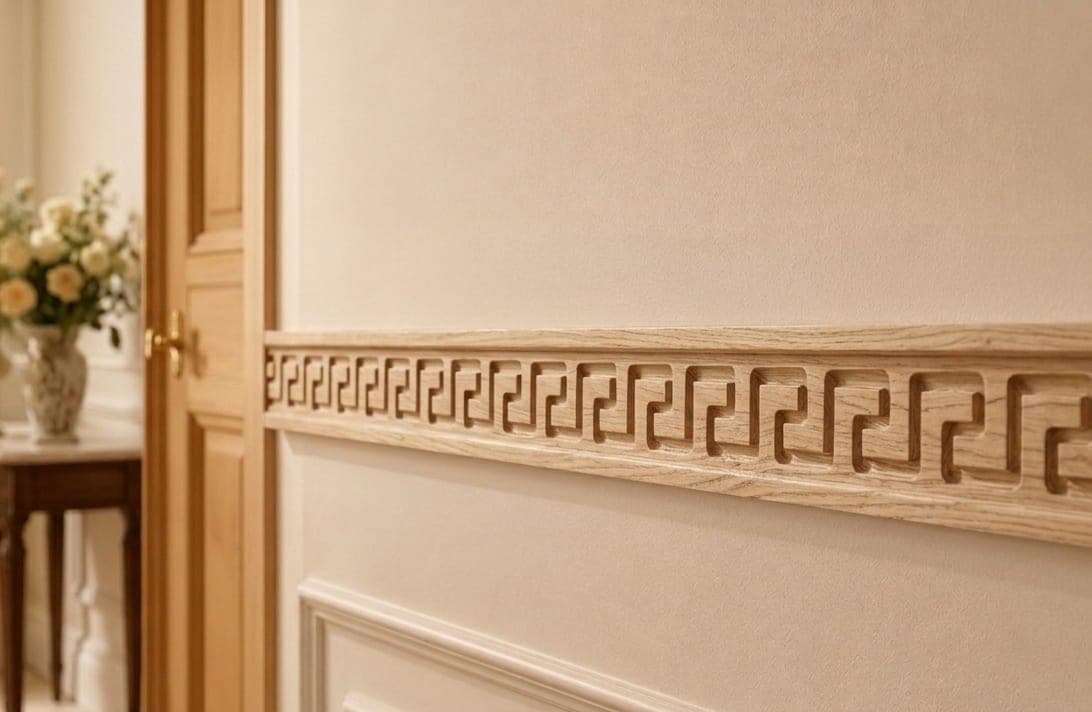
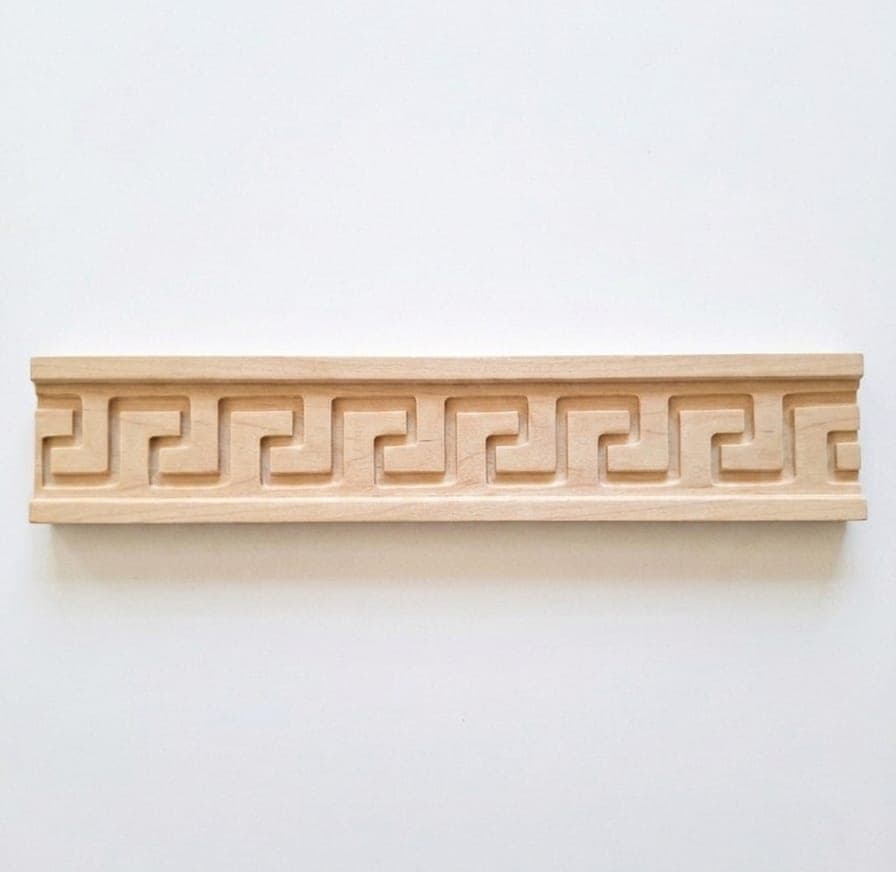
Greek Key Dado Rail in unfinished solid wood, with a Greek key frieze in relief

What is a Haussmannian moulding?

The term covers the moulded décor of the apartments built in the wake of the great Paris works: cornices and ceiling roses above, panel frames on the walls, architraves around the doors. Baron Haussmann was Prefect of the Seine from 1853 to 1870, but his name, as the Pavillon de l'Arsenal points out, has come to stand for a whole century of building. The historian François Loyer places the real break with post-Haussmann architecture in the 1890s and 1900s: a so-called Haussmannian moulding may therefore date from well after the Second Empire.

Indoors, the Haussmann style borrows from earlier periods, and readily from the eighteenth century. According to the Musée des Arts Décoratifs, Empress Eugénie was so taken with Marie-Antoinette that the neo-Louis XVI style became known as 'Louis XVI-Impératrice'. Above all, Loyer shows how industry brought this luxury within reach of the bourgeoisie: machine-cut mouldings, marble fireplaces carved in series, large mirrors. The drawing room became a more modest version of the state rooms of Louis XV's time, with its trio of fireplace, mirror and chandelier.

Plaster, staff or wood: what is Haussmann décor made of?

Plaster rules the ceiling, wood the joinery. Cornices were either run in place with a profile template or cast, and ceiling roses were cast, often in staff, a plaster reinforced with tow that was patented in 1856 and is known in Britain as fibrous plaster. According to Loyer, staff enjoyed 'a considerable vogue' from the very start of the Second Empire, giving rise to a whole industry in the Plaisance district of Paris. The cornice also has a job to do: it hides the often uneven junction between wall and ceiling, and can even make a low room look taller.

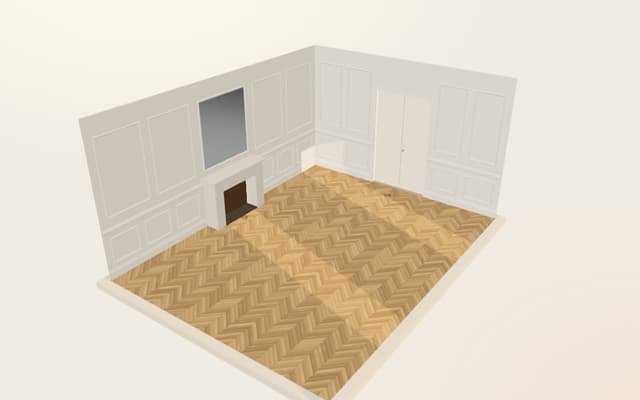
In wood, doors and windows began to be made in small series under the Second Empire, and the Haussmann door gained architraves laden with mouldings; the most luxurious parquet floors were laid in a chevron pattern, the French point de Hongrie. Wood also dressed the lower walls with 'faux-lambris', or mock panelling: moulded strips nailed straight onto the wall, imitating true panelling at a fraction of the cost. The boundary is not clear-cut: under the Bourbon Restoration (1814-1830), the first cornices were wooden profiles nailed along the edge of the ceiling.

How can you tell what is original, and whether it is wood or plaster?

Joints and breaks give the first clues. A wooden moulding is fitted in lengths: you can make out joints between two strips or at the corners, sometimes nail heads under the paint. A run cornice usually continues in one piece, while staff is fixed in sections, glued or bedded in plaster. Where a piece has chipped, wood shows its fibres and plaster a whitish break, reinforced with tow if it is staff. Under thick layers of paint the two can look alike: in that case, have a professional examine an inconspicuous corner.

Consistency then tells you what is original. Identical profiles from one reception room to the next suggest a unified scheme; a profile that changes halfway along a wall points to a later repair, and a cornice cut off sharply by a partition betrays a room that has been reconfigured. The street-facing rooms, used for receiving guests, had the richest décor: a simpler vocabulary on the courtyard side is nothing to worry about.

For a damaged plaster cornice or ceiling rose, contact a fibrous plasterer, a plâtrier-staffeur in French, whose trade is making and restoring this kind of décor. Old woodwork that can be saved should go to a restorer, who will assess its condition before any work. When the wooden element has disappeared or can no longer be saved, the answer is a new piece made to match.
Renovating a Haussmann apartment: what can a woodwork workshop do?

It makes what is missing in new wood, without touching the original material. A length of mock panelling torn off during building work, a broken ornament, part of a lost panel: from a fragment, a survey or clear photographs, we reproduce the element to match, profile and ornament included. That is the principle of our antique boiserie reproduction service. We do not restore old woodwork (a partner restorer can take this on), and we do not supply plaster, staff, doors or parquet.

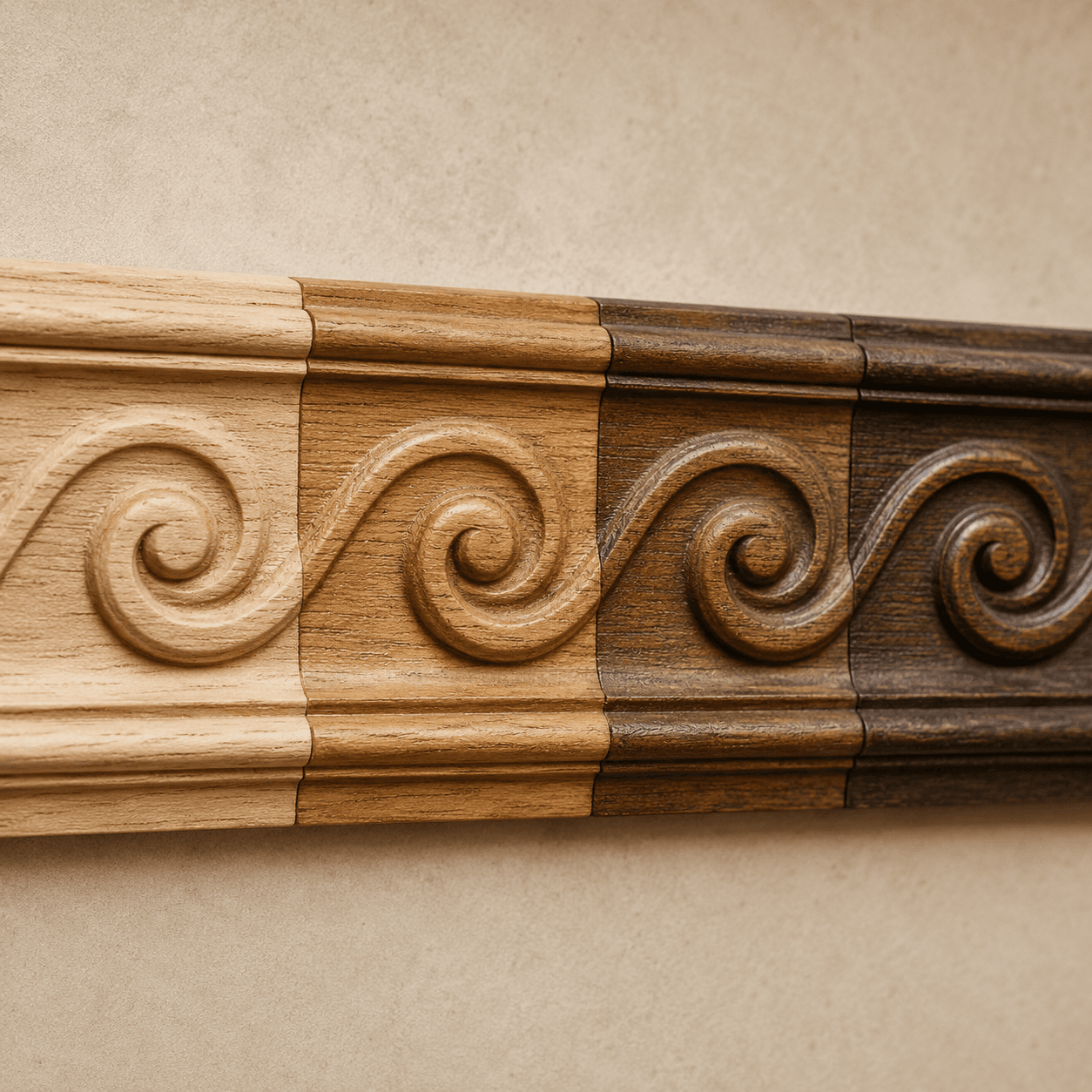
Where the décor has gone, or in a recent interior, solid wood mouldings and dado rails can evoke the Haussmann spirit. Their Neoclassical ornaments, Greek key, beads or water leaves, suit the neo-Louis XVI taste of the Second Empire: our Greek Key Dado Rail is one example, and a profile made to your dimensions falls under our bespoke woodwork. Each piece is designed in 3D and made in our workshop in Cornebarrieu, near Toulouse, then finished and detailed by hand.

How can you recreate the Haussmann spirit with wooden mouldings, without pastiche?

By relying on regularity rather than accumulation: Haussmann décor repeats the same profiles from room to room, and that discipline is what gives it character. Choose a single frame profile per room, align the frames on the axes of the doors and windows, and leave equal margins between them. A wooden dado rail sets the reference line at leaning height, the hauteur d'appui that the Littré dictionary puts at about one metre; at the Petit Trianon, the Bibliothèque nationale de France notes, it was aligned with the height of the room's tables.

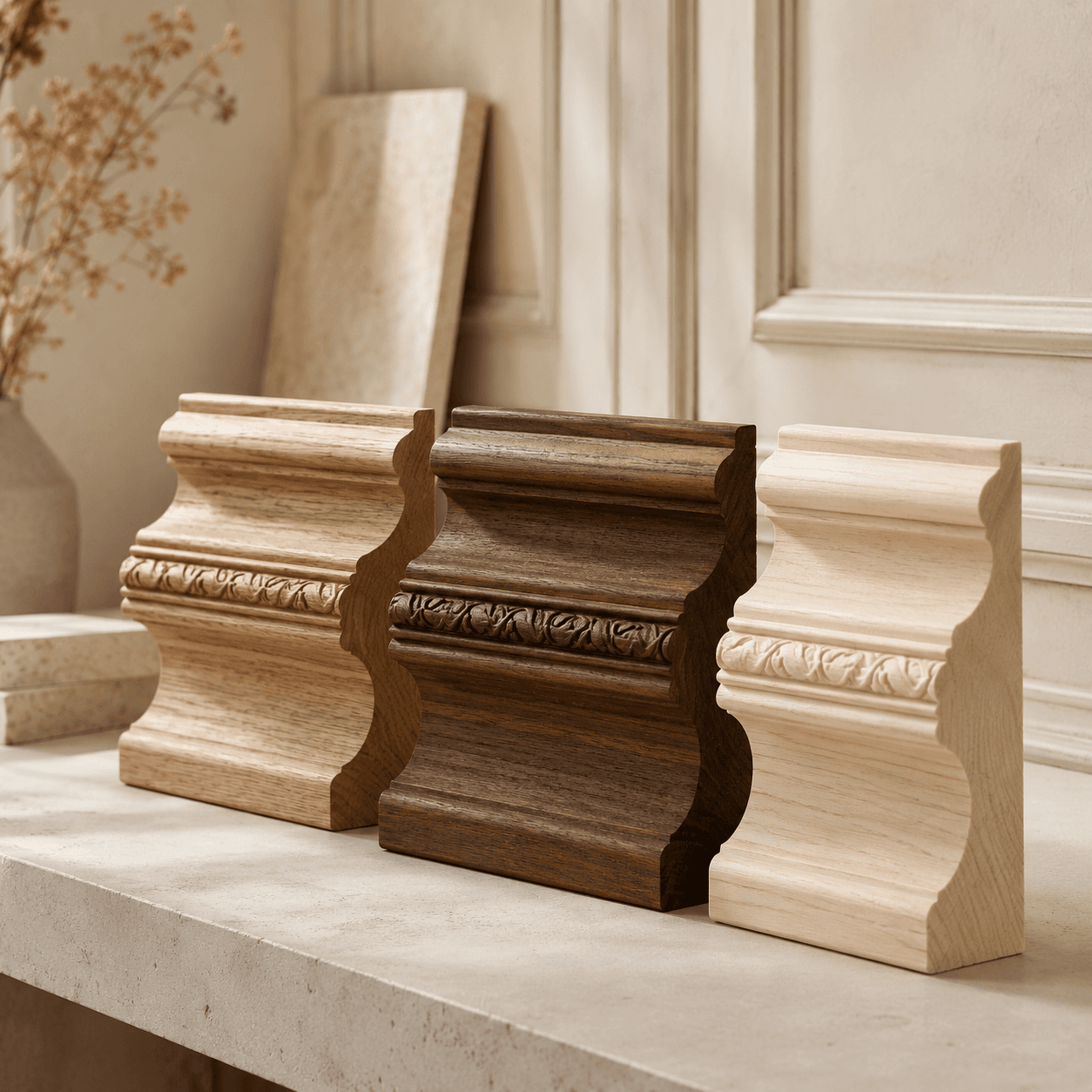
Keep ornament for the lines that matter, a carved dado rail above plain frames for instance, and save the most elaborate décor for the reception rooms. Painted the colour of the wall, mouldings play with shadow; poplar, pale and even, takes paint well. Left as bare wood, oak and walnut show their grain. Our guide to decorative wood mouldings covers profiles and ornament in detail.

A Haussmann apartment in Paris: how do you work with a workshop near Toulouse?

Remotely, and nothing is made before you approve it. Start with overall and close-up photos, with a tape measure visible in the frame, and the main dimensions. The best evidence remains an original fragment, even a broken one, sent by parcel; failing that, a template of the profile traced on card or a dimensioned section. We draw the piece, you approve the drawing, then it is delivered ready to be fitted by the professional of your choice, with whom we are happy to liaise, or by you, for a dado rail.

On-site surveys take place mainly in Occitanie, where the style has its own landmarks: in Toulouse, the Rue d'Alsace-Lorraine, opened between 1869 and 1873, is one of the city's Haussmann-style streets. In a French copropriété, or co-owned apartment building, work inside the apartment does not normally require permission, but anything affecting the common parts or the outward appearance of the building must be voted on at the general meeting, following a request to the managing agent (syndic). The workshop replies within 48 working hours: describe your project.

Frequently asked questions

Are Haussmannian mouldings made of wood or plaster?

On the ceiling they are usually plaster: cornices were run in place with a template or cast, and ceiling roses were cast, often in staff, a plaster reinforced with tow that was highly fashionable from the Second Empire onwards. Wood is found mainly in the doors, architraves, windows and parquet, and sometimes in the panel frames on the lower walls, made of nailed moulded strips. Some older cornices, dating from the Bourbon Restoration, were made of wood.

How do you recognise a Haussmann apartment?

Indoors, several clues add up: plaster cornices and ceiling roses, parquet floors, laid in chevron in the most luxurious apartments, marble fireplaces often carved in series, large mirrors, moulded doors and architraves. The reception rooms usually face the street. The building most often dates from the second half of the nineteenth century, as the type lasted until around 1900.

Who can restore a damaged plaster cornice?

This is the work of a fibrous plasterer, known in France as a staffeur-ornemaniste or plâtrier-staffeur. They make and restore cornices, period mouldings and ceiling roses in fibrous plaster or stucco, taking a template of the existing profile to remake the missing parts. A woodwork workshop does not work on plaster: it makes pieces in wood, for example a lost wooden moulding or ornament, reproduced to match from a fragment or photographs.

Can you recreate the Haussmann style in a modern apartment?

Yes, provided you keep it restrained. Wooden wall mouldings forming frames, a dado rail at leaning height, about a metre from the floor, and a single vocabulary of ornament, beads, water leaves or Greek key, are enough to evoke the Haussmann spirit. What matters most is regularity: the same profiles, frames aligned with the doors and windows, equal margins. Painted the colour of the wall, these mouldings remain discreet.

Can a wooden moulding be reproduced without an on-site survey?

Yes, if the information you send is sufficient. AC Boiseries, a workshop based in Cornebarrieu near Toulouse, works remotely from photographs, dimensions, a template or, better still, an original fragment sent by parcel. The drawing of the piece is submitted to the client before anything is made, then the piece is delivered ready to be fitted by the professional of their choice. On-site surveys take place mainly in Occitanie.

Haussmann style

A Haussmann interior to complete?

Send a few photos, dimensions or a fragment: the workshop replies within 48 working hours and tells you what can be made in wood.

Describe my project