Design my room in 3DMy room in 3D

Occitan emblem

The Occitan cross in solid wood: the emblem of Toulouse and Languedoc

Four arms opening like the bows of keys, twelve golden pommels: the Occitan cross is recognisable at a glance, from the Place du Capitole to the coat of arms of the Occitanie region. Before hanging one at home, it is worth knowing where it comes from, what the sources really say and what belongs to legend. This page sets out the facts, then presents our solid wood Occitan cross, made near Toulouse.

Occitan cross in solid wood

What is the Occitan cross?

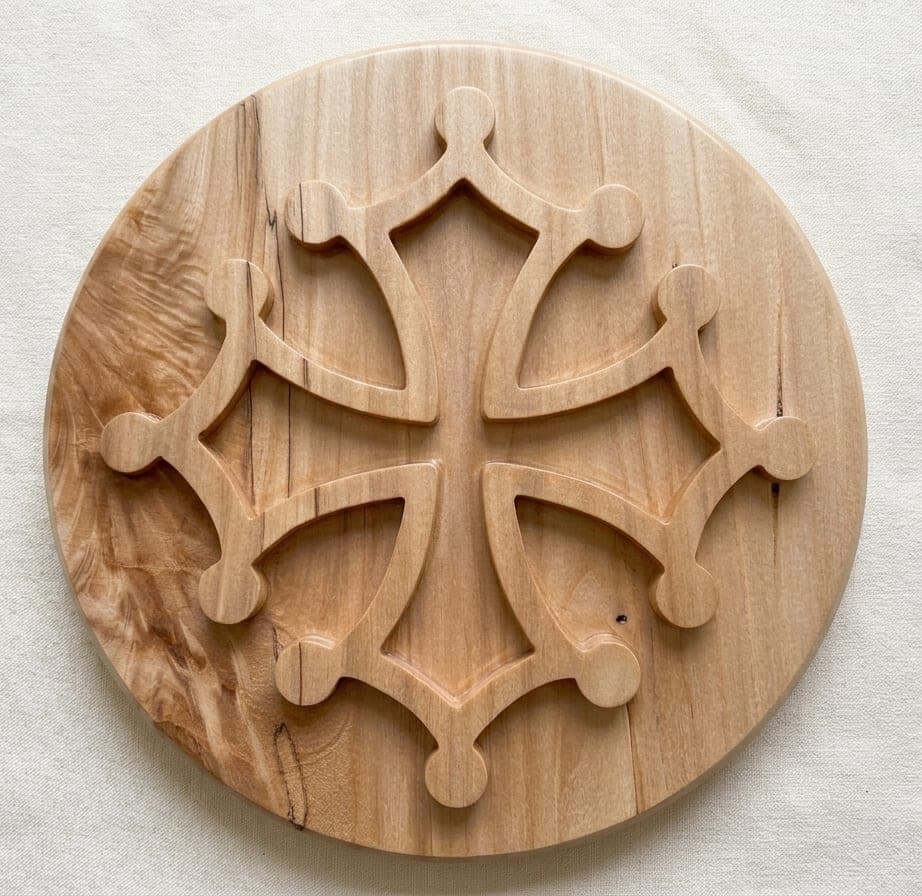
The Occitan cross, also called the Cross of Toulouse or the Cross of Languedoc, is first of all a heraldic figure. Heralds describe it in a single line: 'Gules, a cross clechée, voided and pommetty Or', in other words a gold cross on a red field. It has twelve pommels, three at the end of each of its four arms. In the Song of the Albigensian Crusade, it already has a name, the crotz ramondenca, the cross of the Counts Raymond.

Each word of the blazon has a precise meaning. Voided: the cross is hollowed out, letting the field of the shield show through. Clechée: its ends curve like the bow of an old key, clé in French, which may be where the name comes from. Pommetty: each point ends in a small ball. This silhouette, both cut-out and rounded, explains why it can be recognised from afar, and why it lends itself so well to relief.
Where does the Cross of Toulouse come from?

Historians see it appear in the second half of the twelfth century, in the emblems of the Counts of Toulouse. One firm landmark: on the reverse of Raymond VI's seal, dated 1204, the count gallops with his lance couched and his shield bears the cross. The medievalist Laurent Macé, who devoted a book to the seals of this house, sees in it 'a communication tool of undeniable effectiveness', asserting the family's authority over its neighbours.

Its exact origin is still debated. In 1950, the archaeologist Henri Rolland argued for a Provençal origin, around Venasque and the Marquisate of Provence, which the Counts of Toulouse had held since 1125. You may also read that Raymond IV adopted it as early as the First Crusade, but no seal of this count is known. What followed is better established: the cross entered the arms of Toulouse, fixed in the fourteenth century, and under the Ancien Régime became the emblem of the province of Languedoc.

What do the twelve pommels mean?

It is the question everyone asks, and the honest answer is simple: nobody knows. The pommels have been linked to the twelve signs of the zodiac, the twelve months of the year or the twelve apostles, and the four arms to the four seasons. These readings have circulated for a long time, but none can be established with certainty: they are interpretations, sometimes lovely legends, not the proven intention of those who designed the cross.

Toulouse has in fact played with the idea. In 1995, the painter and sculptor Raymond Moretti, commissioned to decorate the Place du Capitole, set the signs of the zodiac in the twelve balls of the great bronze cross, also evoking the months and the hours. It is an artist's work, not historical proof. Above all, it shows how a medieval emblem keeps gathering new meaning.

Where can you see the Occitan cross today?

It remains very present across the south of France, and not only as decoration. The arms of Toulouse show a lamb carrying the cross, between the Château Narbonnais and the Basilica of Saint-Sernin. Since the 2015 territorial reform, the cross has served as the emblem of the Occitanie region, whose coat of arms places it at the heart of the shield. It also appears in the arms of départements such as Haute-Garonne, Tarn and Hérault, and in those of many towns, Blagnac and Aucamville among them.

This presence explains its success as an object. People give it as a leaving present, hang it in a family home, or display it to show their attachment to a language and a land. But it is first and foremost a heraldic emblem, and its shape does not tolerate approximation: arms too thin, pommels poorly spaced, and the cross loses its balance. A version in relief therefore calls, above all, for accurate drawing.

Choosing and ordering a wooden Occitan cross

Our solid wood Occitan cross follows the silhouette of the Cross of Toulouse and its twelve pommels. The natural grain of the wood and a crisp relief are enough to bring its lines to life, in a hallway, a living room or a holiday home. It is designed in 3D, made in our workshop in Cornebarrieu, near Toulouse, then finished and detailed by hand. Size and price are given on its product page.

For a bespoke version, choose the wood according to the finish: oak or walnut to keep the wood visible under wax or varnish, poplar for paint, for example to recreate the gold cross on a red field. Mount it near a window: daylight from the side brings out its relief. On a wall already crowded with frames, give it room to breathe.

Another size, a cross set within a shield, a particular colour? The workshop can study a bespoke piece. Our other heraldic pieces are gathered in the Coats of Arms & Portraits collection. You can fix it yourself or have your joiner fit it; we give you the information you need. A question about the design or the wood? Write to us.

Frequently asked questions

What is the difference between the Cathar cross and the Occitan cross?

The Occitan cross is a heraldic emblem, that of the Counts of Toulouse and then of the province of Languedoc, known from their seals and coats of arms. The 'Cathar cross', on the other hand, has no historical existence: the Cathars rejected the cross as a symbol. Today the phrase refers either to the Occitan cross itself, linked to Catharism in the twentieth century, or to equal-armed crosses set in a circle, sold as jewellery or souvenirs.

Is the Occitan cross a religious symbol?

Not primarily. Its shape naturally recalls the Christian cross, but its use is that of a coat of arms: identifying a house, that of the Counts of Toulouse, then a province, Languedoc, and today a region and many towns. The religious readings in circulation, the twelve apostles for the pommels or the Trinity for their groups of three, are interpretation or legend. So you can display it as a regional emblem, whether or not you are a believer.

What does the Occitan flag mean?

The Occitan flag takes up the arms of the Counts of Toulouse: a gold Occitan cross on a red field, the gules of the coat of arms. One variant adds the seven-pointed star of the Félibrige, a movement founded in 1854 by seven Provençal poets: its points recall those founders, and are also read as seven great Occitan provinces. François Fontan added it to the cross to distinguish this flag from that of Languedoc.

How long does it take to receive an Occitan cross?

The dispatch time is shown on the product page, and the date is confirmed when you order, or with the quotation for a particular wood, finish or size. The workshop replies within 48 working hours. For a gift with a fixed date, a leaving present or a birthday, mention it in your first message: the workshop will tell you whether it can be met. Delivery outside France is studied case by case.

What are the symbols of Occitania?

The main one is the Occitan cross, gold on red, found on the Occitan flag and, since the 2015 territorial reform, in the emblem of the Occitanie region. To it are added the seven-pointed star of the Félibrige, often paired with the cross, and a song, Se canta, regarded since the twentieth century as the anthem of Occitania; tradition attributes it to Gaston Fébus, though no texts of his time confirm it.

Occitan emblem

The Occitan cross, in solid wood

Choose the wood and finish on the product page, or describe a particular project to us: the workshop will reply.

See the product page