Ready to ship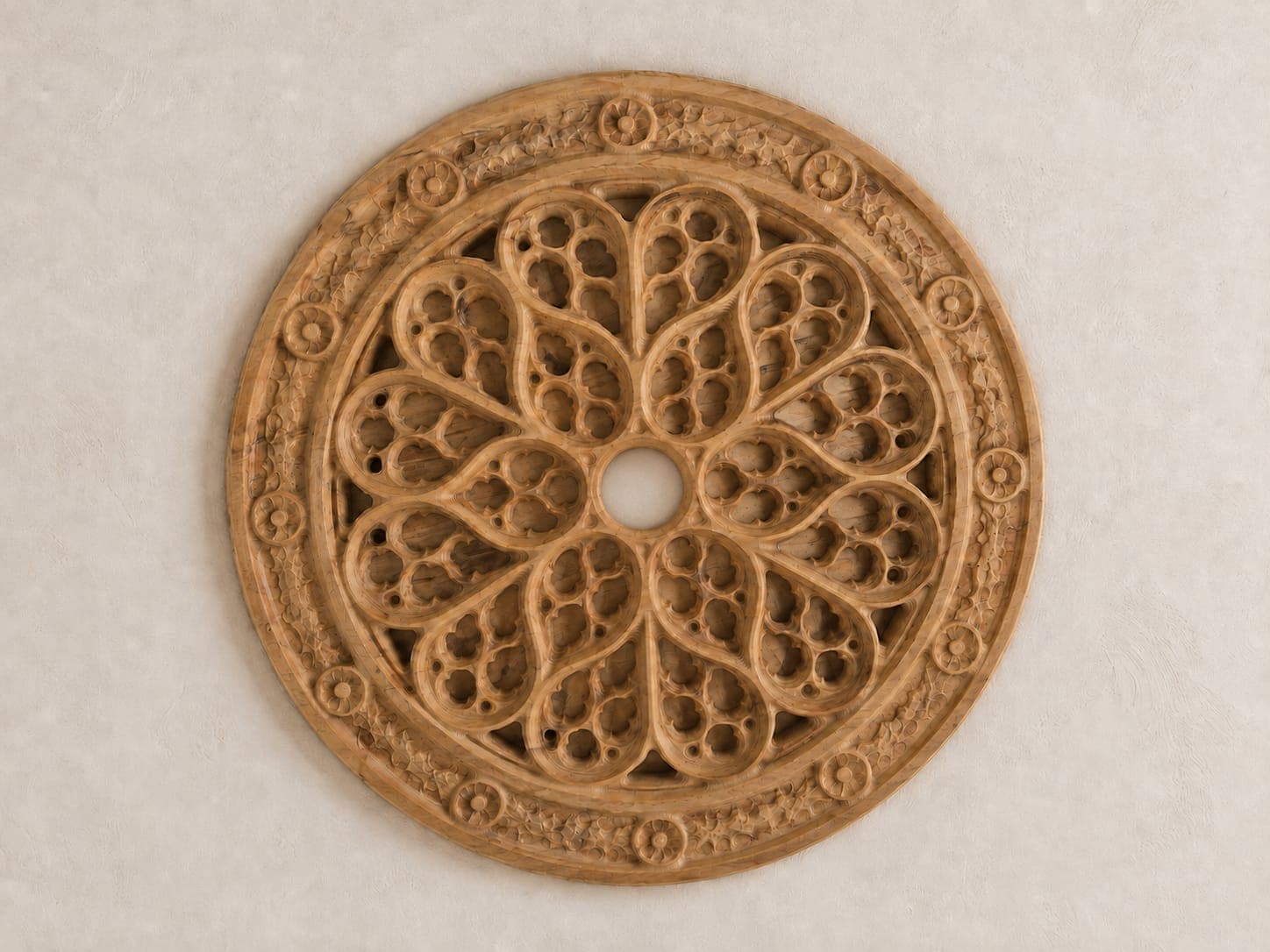
Coats of Arms & Portraits
Radiant Rosette
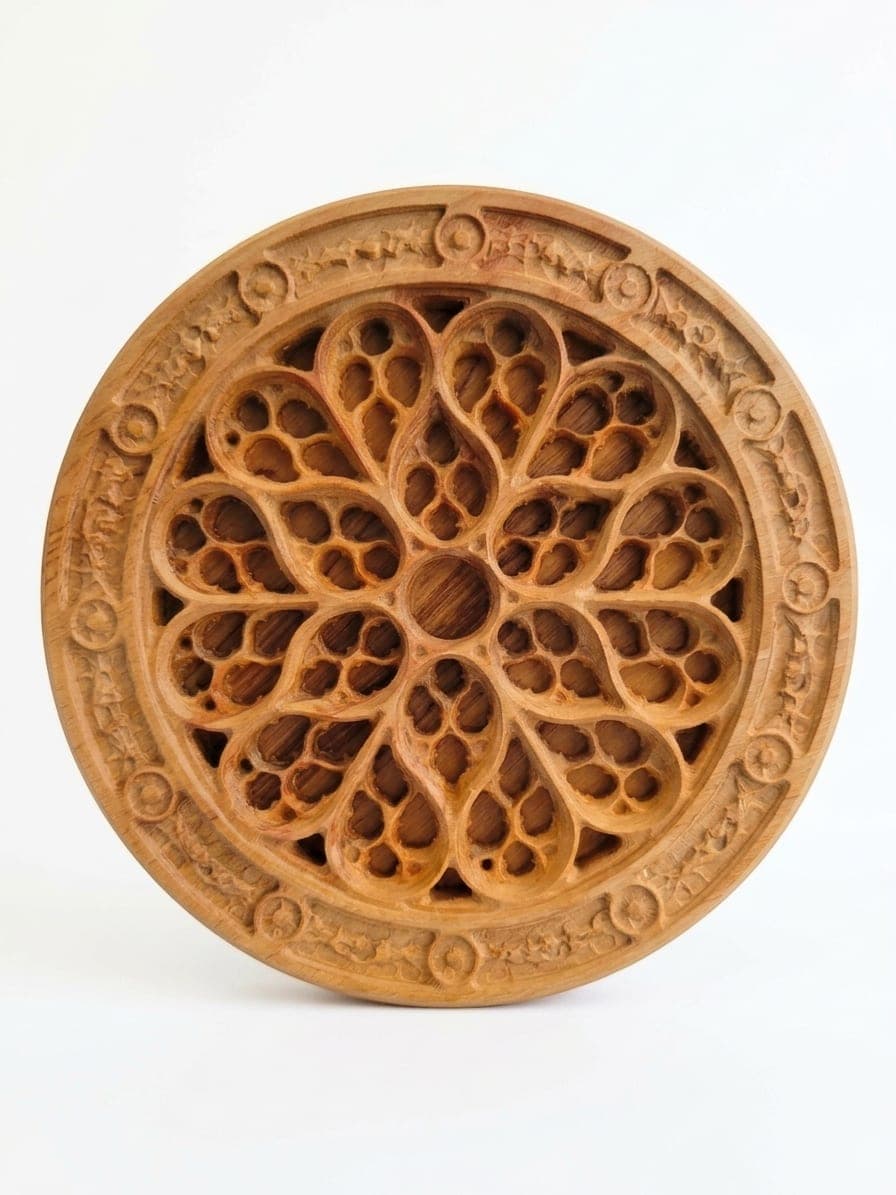
Inspired by the south transept rose window of Beauvais Cathedral, this piece is equally at home on a wall, above a door or as part of a ceiling medallion.
Ø 26 cm · Poplar, Pine
€120.00
ViewCeiling ornament
At the centre of a ceiling, above a door or at the heart of a coffer, a rosette gives the eye an anchor point. We often picture it in plaster, in period apartments; in solid wood, it gains a relief and a warmth that paint alone cannot give. Here is where this ornament comes from, where to place it, how to choose the wood and finish, and which rosettes the workshop makes near Toulouse.
A rosette is a circular ornament whose elements, petals, leaves or rays, are arranged around a central boss, like a rose in full bloom. The Académie française's dictionary places it mainly on ceilings, cornices and the coffers of vaults; in joinery, it also decorates furniture. On a ceiling, it is known in Britain as a ceiling rose, and in the United States as a ceiling medallion. In French, the same word, rosace, also names the great round stained-glass window of Gothic churches, more properly called a rose window.
Historically, rosace meant the carved ornament and rose the window. The distinction blurred in the nineteenth century, but it remains useful: a ceiling rose is a solid relief, with no opening, seen from below and often from a distance. Its design must therefore stay legible from afar, with bold relief rather than a lace of fine detail.
The idea is ancient. At the Parthenon, the coffered marble ceilings bore a painted floral motif, a rosette or a lotus flower, at the back of each compartment. The Romans built coffered ceilings in great numbers, in concrete, stucco and wood: at Herculaneum, a first-century wooden coffered ceiling was uncovered in 2009. The Renaissance brought these ceilings back into fashion.
In the eighteenth and nineteenth centuries, the rosette belonged to the standard repertoire: the Louis XVI and Empire styles carved it among beads, palmettes and acanthus leaves. In the nineteenth century, staff, a fibre-reinforced plaster patented in 1856 and again in 1861, and known in Britain as fibrous plaster, made it possible to prepare cornices and ornaments in advance, and the central rose readily hosted the chandelier. A legend also circulates: among the Romans, a rose on the ceiling was supposedly a reminder to guests to keep secret whatever was said sub rosa, 'under the rose'.
Compared with moulded rosettes, solid wood offers something different: relief formed in the solid wood, visible grain and a material that accepts wax, stain, paint or gilding. It lets you match the rosette to beams, a parquet floor or existing panelling, and use it away from the ceiling, on a wall, a door or a piece of furniture. It is also a piece that can be sanded and whose finish can be renewed over the years.
The wood follows the finish. Oak and walnut are best left as bare wood, waxed or varnished; poplar, pale and even, is better suited to paint that makes you forget the wood and keeps only the design. A solid wood rosette has real weight: on a ceiling, it is fixed mechanically into a sound substrate, and your joiner chooses the fixings. If a light fitting is connected to it, call in an electrician.
On a ceiling, the classic place is the centre of the room, around the light point, or the heart of a coffer. But a wooden rosette also works vertically: above a door, as a medallion at the centre of a panel, as an echo above a fireplace or a bedhead. To judge the size, nothing beats a cardboard template held in the intended spot and viewed from the doorway.
The design matters as much as the position. A radiating rosette, with regular rays or lobes, suits classical schemes as well as understated interiors; a foliate rosette calls rather for a period setting. In a room that already has mouldings, repeat an existing ornament, a bead, a water leaf, so that the rosette talks to the cornices instead of clashing with them.
Our Radiant Rosette is inspired by the south transept rose window of Beauvais Cathedral, a Flamboyant Gothic rose eleven metres in diameter. It finds its place on a wall, above a door or as part of a ceiling piece. Like our other pieces, it is designed in 3D, made in our workshop in Cornebarrieu, near Toulouse, then finished and detailed by hand.
For a whole ceiling, our Ceiling Medallion or Coffer offer studies a complete scheme from a survey, and our bespoke service can adapt the diameter, design and finish to your room. Has an old wooden rosette disappeared or broken? We can make a new copy to match, as part of our antique boiserie reproduction service. Fitting remains with your joiner, to whom we send the information needed.
A moulded polyurethane rose, very light, is simply glued in place. A solid wood rose weighs more: adhesive only helps, and the piece is fixed mechanically, with screws into a joist or the structure, or with wall plugs suited to the substrate and the weight. The ceiling must be sound and flat. The screws can be hidden in the relief and then disappear under the finish; choosing them is up to your joiner.
There is no standard: the diameter is proportioned to the room, the ceiling height and the light fitting. Makers of moulded roses give rough guides: 30 to 40 cm for rooms under 12 m², 40 to 60 cm from 12 to 20 m², 60 to 80 cm from 20 to 30 m², and more beyond that or under a high ceiling. In solid wood, which is heavier, the diameter also depends on what the ceiling can carry.
Not from the rose itself, which is not designed to carry a light fitting. The chandelier stays suspended from its hook or bracket, anchored in the ceiling structure; the rose goes around it, and the cable passes through a central hole. That was precisely its role in the nineteenth century: framing the light point. The electrical connection must be left to an electrician.
It depends on the rosette. In Gothic churches, the great rose window often depicts an order of the world: Christ or the Virgin at the centre, surrounded by the Evangelists, the apostles or the prophets, sometimes the signs of the zodiac and the labours of the months. The ceiling rose, for its part, is first and foremost a floral ornament inherited from Antiquity, with no set message.
Moulded roses, in polyurethane or plaster, are sold in DIY stores or by fibrous plasterers. In wood, the choice is scarcer: you sometimes find antique rosettes at antique dealers' or in architectural salvage yards, but their diameter and style do not always suit. A woodwork workshop can make a new one in solid wood, as a catalogue design or made to measure, in the wood and finish chosen with you.
Coats of Arms & Portraits
Inspired by the south transept rose window of Beauvais Cathedral, this piece is equally at home on a wall, above a door or as part of a ceiling medallion.
Ø 26 cm · Poplar, Pine
€120.00
View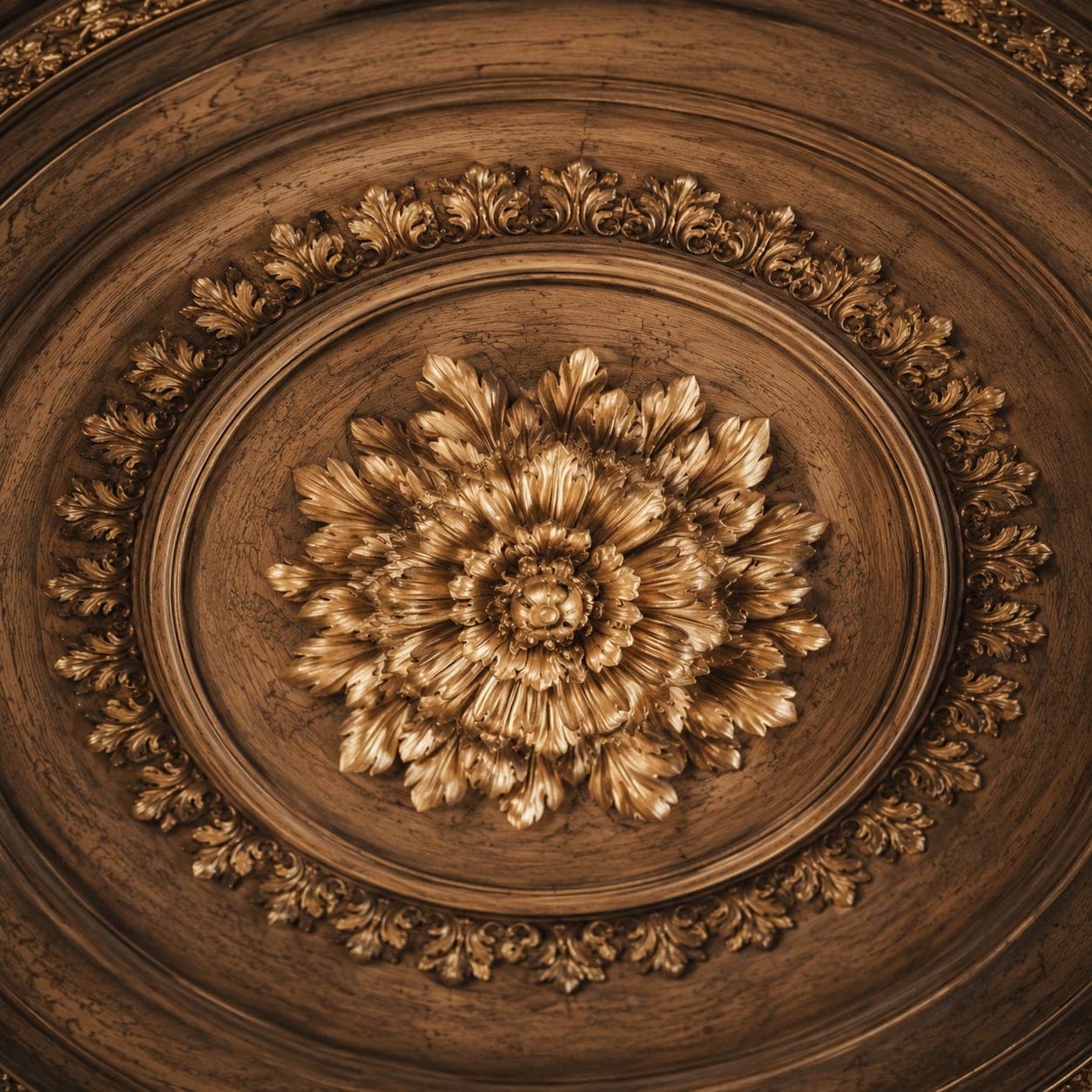
Bespoke
A coffer or ceiling decoration, designed as part of a complete architectural project.
Project based on a site survey · Oak, Walnut
From€350.00
ViewClassical mouldings
Decorative wood mouldings: profiles, ornament and period styles
Decorative wood mouldings explained: ovolo and cyma profiles, egg-and-dart and Greek key ornament, French period styles and our solid wood dado rails.
Châteaux and historic houses
Château and period house boiseries: making what is missing to match
Château or period house boiseries to complete: new solid wood pieces made to match, the rules for protected French monuments, and how our workshop works.
Made to match
Antique boiserie reproduction, made to match
A missing moulding, a damaged panel, an antique boiserie to complete: we reproduce the element to match in solid wood, ready to be fitted by your joiner.
Ceiling ornament
Diameter, design, wood: describe the room and the ceiling, and the workshop will tell you what is possible.
Describe my project