The traditional art of woodwork: a decryption
Why do the same acanthus leaves, the same vases, the same palmettes appear everywhere from Rome to Versailles? If there truly is a tradition, what is it? And how far back do these symbols reach, symbols we pass by every day without ever looking up?
Wood, a sacred material
Before it was a material, wood was a tree. And to the Ancients, a tree was a presence. Cutting one down was never a trivial act.
In the Near East, the cedar of Lebanon was the wood of the gods. The Epic of Gilgamesh tells of the conquest of its sacred forest. The Bible describes the Temple of Solomon, panelled with cedar supplied by Hiram, King of Tyre. On its walls were open flowers, palm trees and cherubim.
The Greeks revered the xoana, wooden statues so ancient they were said to have fallen from the sky. The druids held their rites in oak groves. In Egypt, the body of Osiris lay enclosed within a tree trunk. The sycamore was the tree of the goddess Hathor.
Asia carried this relationship as far as asceticism. The Zhuangzi, a great Taoist text, tells the story of Qing, a man commissioned to carve a bell stand. Before he begins, he fasts for seven days. He forgets his wages, then fame, and at last even his own body. Only then does he enter the forest. There he seeks the tree in which the object already exists.
Chinese carpenters honour Lu Ban, their deified patron. His manual blends building techniques with talismans. In Japan, the kami dwell in trees. Temple carpenters, the miyadaiku, perform rites before every felling. For more than a thousand years, the Ise shrine has been rebuilt every twenty years in hinoki cypress. The sculptors of Buddhas have kept an ideal alive: ittō sanrai, “three bows for every stroke of the chisel.” In India, workers still worship Vishvakarma, the divine architect, every year.
In the lands of Islam, wood becomes prayer through geometry. Carved minbars, such as the one Nur ad-Din had carved for the al-Aqsa Mosque, and mashrabiya screens unfold interlacing patterns with neither beginning nor end. They are an image of the infinite, and of divine unity.
The Christian heritage
Christian Europe inherited this sense of the sacred, and added one more reason for it: Christ himself was a tektōn, the son of a carpenter. Saint Joseph became the patron of those who work with wood. In the Middle Ages, carpenters raised true forests of beams beneath cathedral roofs. In 2019, the fire at Notre-Dame de Paris reminded the whole world of their almost mystical value.
An unbroken transmission
It all begins, so the legend goes, on a tomb. In the first century BC, the Roman architect Vitruvius told the story in his treatise On Architecture.
In Corinth, a young girl dies just as she reaches the age to marry. Her nurse places a basket on her tomb, filled with her familiar belongings. She covers it with a tile. In spring, an acanthus root hidden beneath the basket awakens. Its leaves wind around the wicker, then curl back under the weight of the tile. The sculptor Callimachus happens to pass by. He stops, enchanted. From this vision the Corinthian capital will be born.
Acanthus is a stubborn plant. Uproot it, and it grows back. Born on a tomb, it became the symbol of life stronger than death. Alongside scrolls and shells, it still adorns our solid wood wall panels.
Centuries later, the Renaissance rediscovered Vitruvius. Then the printing press took over. Ornamentists published collections of engraved designs: Jacques Androuet du Cerceau in the sixteenth century, Jean Le Pautre and Jean Berain under Louis XIV, then Nicolas Pineau, one of the inventors of the rococo, under the Regency and Louis XV. These plates travelled from Paris to the provinces, and from France across all of Europe. A village joiner could thus carve the same acanthus as the master of Versailles. We tell the rest of this history of French boiseries in another Journal article.
Symbols that speak to all: vase, vine, pomegranate, palm, shell
If these motifs have survived two thousand years, it is because they carry meaning. Each age has been able to read that meaning anew in its own way.
The vase. In early Christian art, a vine often springs from a kantharos, the two-handled cup. It is the fountain of life. On tombs, the urn holds the ashes, and so, symbolically, the soul. After the excavations at Pompeii, the Louis XVI style spread it everywhere. The vase is also the horn of plenty. To the medieval imagination, it recalls the Grail, the cup of Christ’s blood and the object of every quest. It always says the same thing: that which receives, and that which gives.
The vine. It belonged first to Dionysus, god of intoxication, death and rebirth. Christianity took hold of it. “I am the true vine,” says Christ in the Gospel of John. The grape becomes the wine of the Eucharist. Pagan intoxication becomes sacred rapture. The form remains, the meaning shifts. That is the secret of its long life.
The pomegranate. It already crowned the two bronze pillars, Jachin and Boaz, raised at the entrance to the Temple of Solomon. For the Greeks, it was the fruit of Persephone, binding the world of the living to the world of the dead. The Church Fathers saw in it an image of the community: a thousand seeds beneath a single rind. Unity in multiplicity.
The palm. In Rome, it rewarded the victor. The Book of Revelation places it in the hands of the elect, clothed in white robes. It became the emblem of martyrs, and Palm Sunday still carries it. It speaks of victory, but a victory won through trial.
The shell. Venus was born on a shell, rising from the waves. As the scallop of Saint James, it marks the pilgrims of Compostela. It sometimes pours the water of baptism. In the eighteenth century, the rococo made it its emblem. It unites birth, journey and the rebirth of the soul.
The tree of life. It sums up all the others. We find it in Genesis, on Assyrian reliefs, in Persian carpets, in the diagrams of the Kabbalah. We also find it on the wedding wardrobes of the French countryside, where it wishes the young couple fertility and long life. It is the axis of the world. It joins earth and heaven.
Giving life back to the tree
One question remains, an almost metaphysical one. Why carve leaves and fruit from the very wood of the trees that once bore them?
The sculptor works a material that once lived. The tree had to die to become woodwork. Beneath the chisel, leaves, fruit, vines and flowers are reborn. The artist gives it back a symbolic life: the felled wood begins to grow again. From a coarse state, it is reborn in a subtler one.
This idea of death and rebirth links the acanthus on the Corinthian tomb, the Eucharistic vine and the tree of life. The motifs have changed gods. They have not changed their message. It is up to us to keep them alive every day.
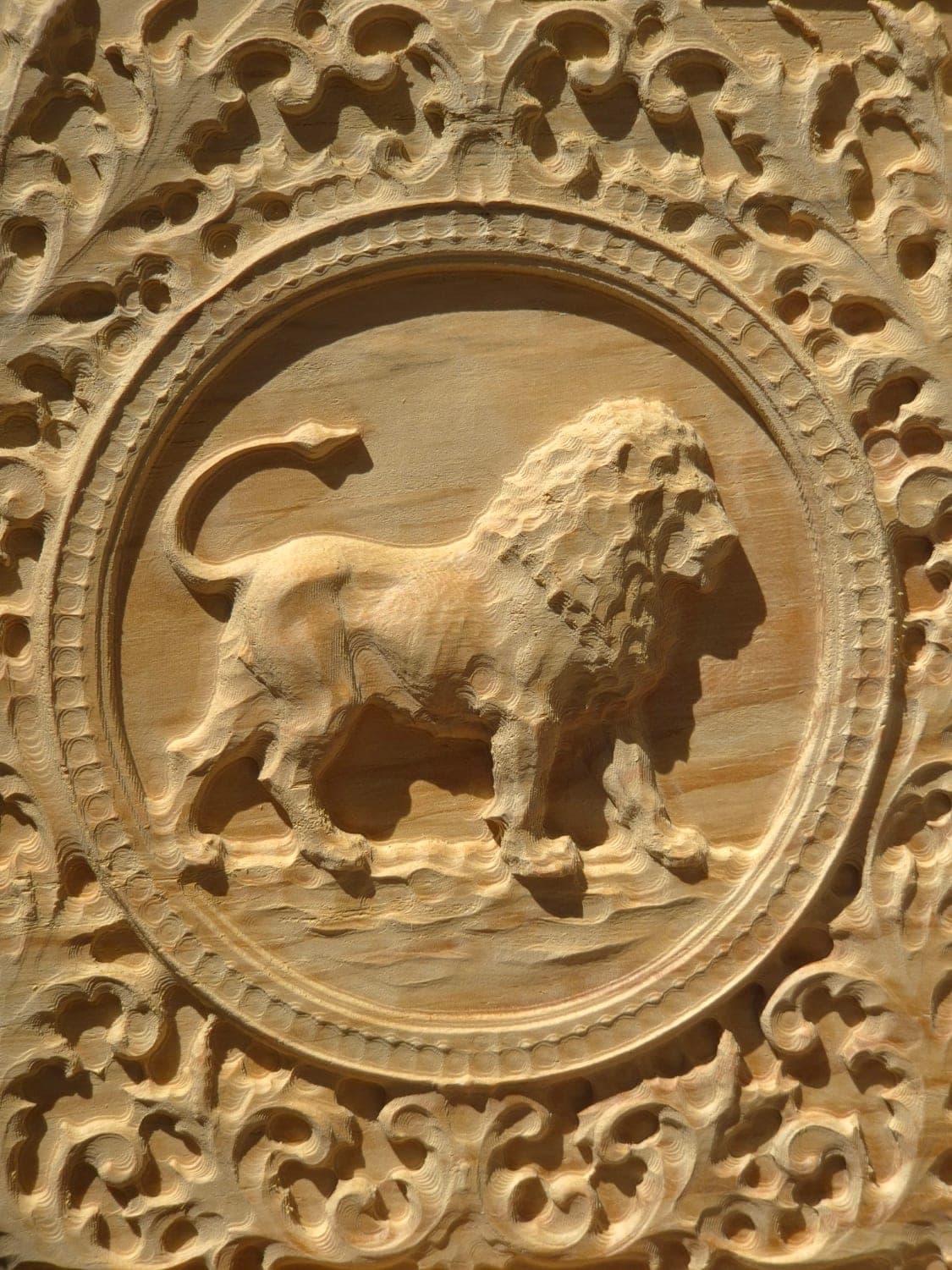
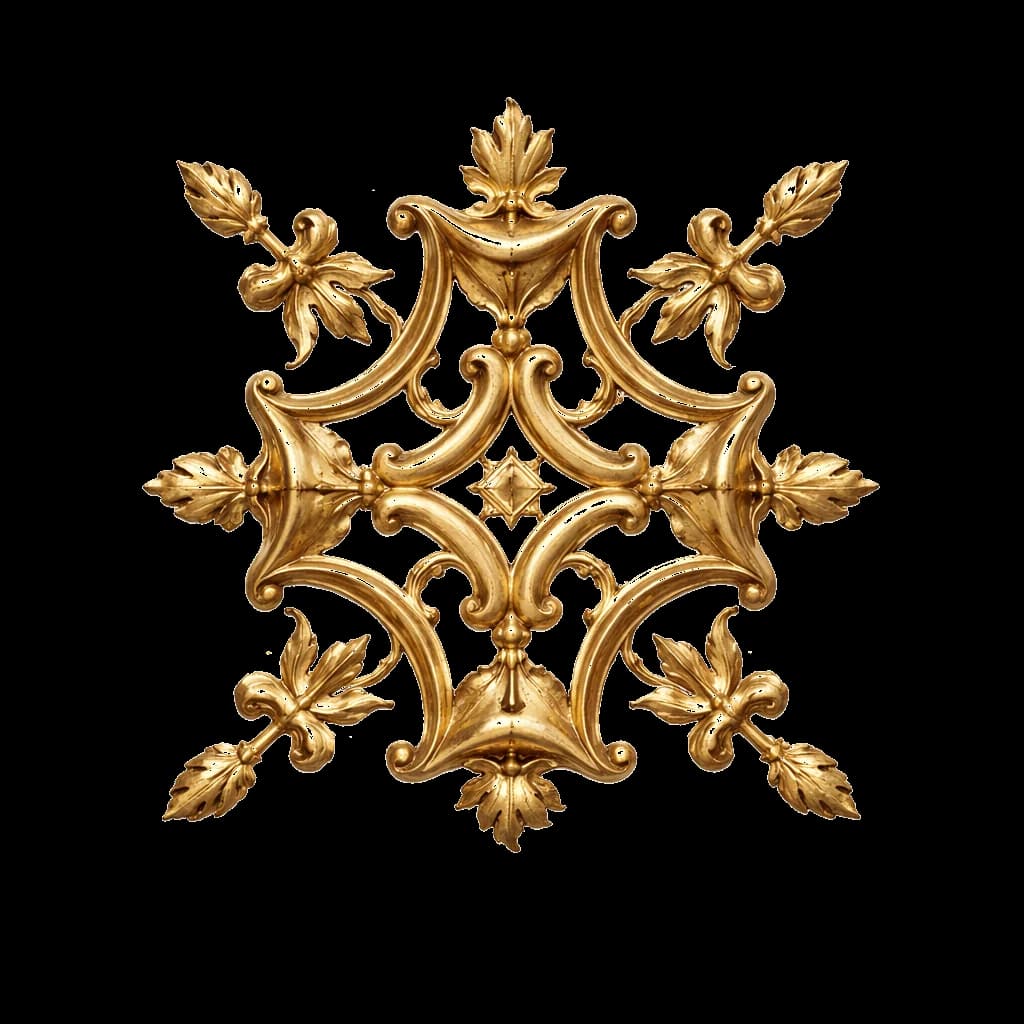
In our workshop, they live on: in the scrolls around our Lion Panel, in the Radiant Rosette, an image of the world’s harmony, or in the endless line of the Greek Key Dado Rail. And in those you will imagine with us, bespoke.
A boiserie to imagine?
The workshop can turn an inspiration, an archive or an existing décor into a bespoke piece.
Discuss the project