Which wood should you choose for a decorative moulding?
By Camciuc Florian · Journal editor · 16 September 2026 · 7 min read
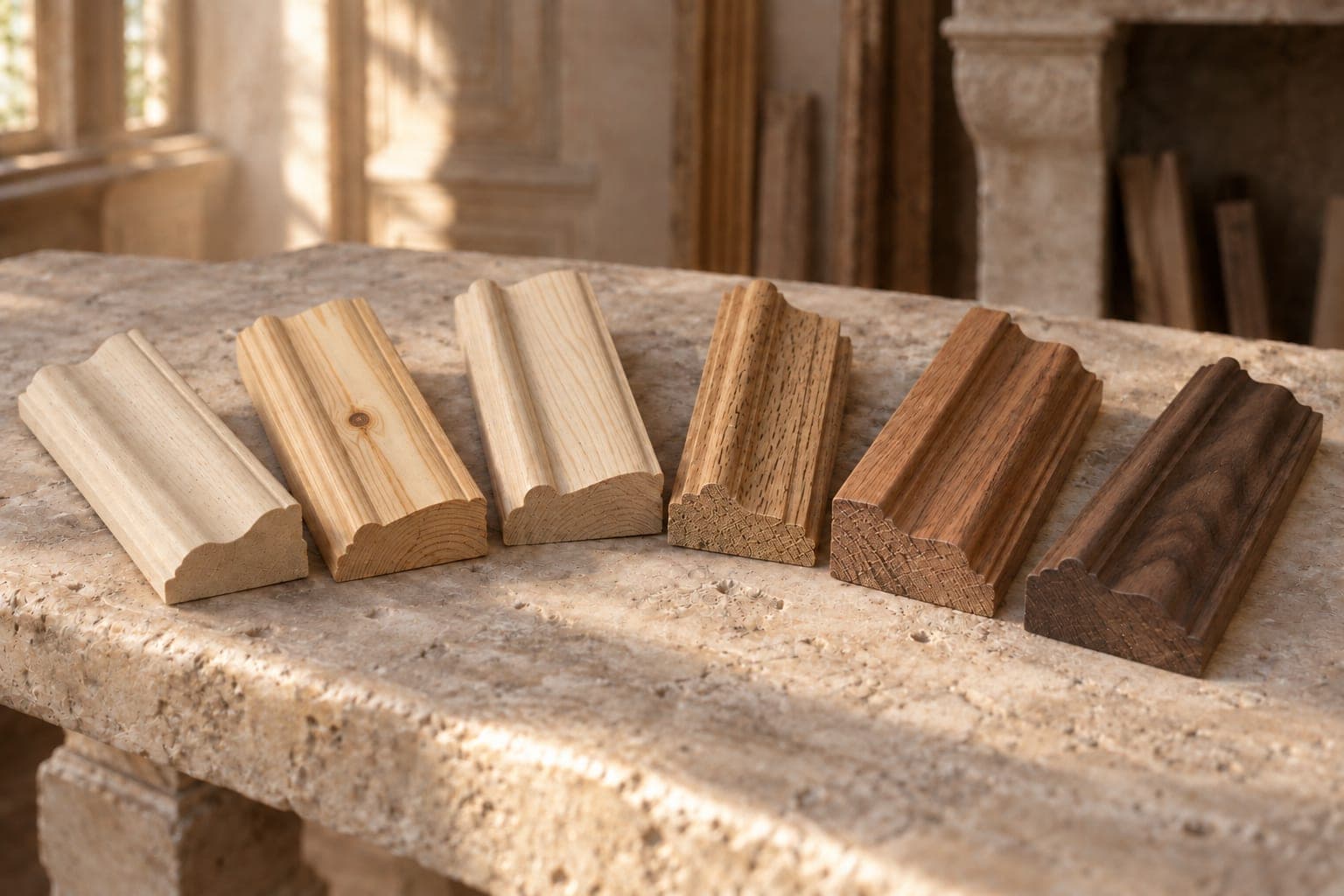
Poplar, pine, fir, oak, sweet chestnut or walnut: the right choice depends on the design of the moulding, the finish you want and the part it will play in the overall scheme.
Key takeaways
- The choice of wood depends on the profile, the finish and the pieces of timber actually available.
- For a painted moulding, poplar is worth exploring; for wood left on show, oak, sweet chestnut and walnut do more to bring out their grain.
- A trial on the intended profile, with the intended finish, remains essential before sign-off.
A moulding is never just a drawing. Depending on the wood chosen, the same profile can look discreet, warm, graphic or more solemn. The grain can emphasise the relief, while a painted finish can, on the contrary, unify the material so that only the lines speak.
So there is no single ideal species for all decorative wood mouldings. The right choice depends on three questions: will the moulding be painted or left with the wood on show? Is its profile fine or generous? Should it blend into the architecture or become a decorative feature in its own right?
The words ‘pine’, ‘fir’, ‘oak’, ‘poplar’ and ‘walnut’ can each cover several species, origins and grades. Drying, grain, knots, resin, the dimensions available and the finish all influence the result. The final choice should therefore be made on identified pieces of timber, not on the generic name of the species alone.
Start with the finish you want
Before comparing species, decide on the final look you are after.
If the aim is a painted surface that looks even, a pale species with little contrast can be a sensible choice. This is an aesthetic direction, not a technical requirement. A trial with the intended primer and paint is still necessary.
Under a clear or lightly tinted finish, the colour, the size of the pores and the figure of the wood remain visible. Oak, sweet chestnut or walnut then play a direct part in the decoration. The compatibility of an oil, wax, varnish or stain should be checked against the species and the result you want.
Two boards of the same species can show different shades and individual features. The choice should always be confirmed on the basis of the profile requested, the dimensions and the expected result.
Poplar for a light, painted moulding
Poplar is a pale, light wood, known for being easy to work and used in interior fit-out. Its appearance nevertheless depends on the species, the way it is sawn and the grade of the pieces selected.
For a dado rail (a chair rail, in American English), a panel moulding or a profile that will take an opaque paint, poplar is a logical option worth testing. The consistency of the lengths, the surface quality and the way it reacts to the paint system must be checked on the pieces actually available.
Pine: a wood with character that calls for careful selection
The term ‘pine’ covers several species. Scots pine, for example, has pale and reddish-brown zones, visible growth rings and a resin content that can vary. The presence, size and soundness of the knots depend heavily on the grade chosen.
Pine is used in joinery and can take a range of finishes. Very resinous pieces can, however, complicate finishing, while dead or loose knots can cause problems as the wood is worked. For a moulding, the grade should be selected according to the degree of regularity required, and a finish trial carried out.
Fir for pale, understated profiles
The word ‘fir’ also covers several species. The available data on firs of the genus Abies generally describe pale, low-density woods that are easy to work and able to take a good finish when the material is well selected.
These characteristics make fir worth considering for interior joinery and understated decorative profiles. This possibility must nevertheless be confirmed according to the exact species, the grade, the moisture content, the dimensions and the finish.
Oak, when the grain is part of the design
European oak is a relatively dense hardwood, widely used in joinery and furniture making. Its pores and grain remain visible under a clear finish, giving the material a strong presence.
It can be considered for profiles, frames, dado panelling and panels in which the wood is to remain visible. The design of the profile should be judged against the actual grain of the piece, not just from a generic sample.
Oak also contains tannins that can react with certain finishing systems and with water. The finishing product should therefore be tested on a representative sample before approval.
Sweet chestnut for grain left on show
Sweet chestnut is used in joinery, furniture making and interior fit-out. Its figure can be shown to advantage when it is left visible, but its appearance varies with the way it is sawn, its growth and the selection of the pieces.
It can be considered for mouldings, panels or dado panelling in which the wood remains visible. Like oak, it contains tannins: a finish trial is needed to prevent coloured bleed-through or unwanted stains.
Walnut for an accent moulding
Common walnut can show grey to brown wood with darker streaks running through it. It has historically been used in decorative joinery, furniture, veneer and interior panels.
It can be considered when the wood is to remain visible and its colour is part of the project: an accent moulding, a frame, a bookcase or a decorative panel. The result depends heavily on the piece selected, as colour and figure can vary.
On a piece that is to be painted all over, walnut’s own visual appeal is largely lost. This is not a technical impossibility but an aesthetic and economic trade-off.
Which wood for the result you want?
A painted, visually even surface: look at poplar, or a carefully selected pine or fir. Check the knots, resin, surface quality and compatibility with the paint.
Visible wood with a pronounced grain: compare oak and sweet chestnut, taking account of tannins and the finish.
Darker tones: consider walnut, after checking the colour, consistency and dimensions of the batch.
A highly detailed profile: never choose a species on its name alone. Examine the grain, defects and drying, and carry out a trial on the actual profile.
Long, matching lengths: check straightness, moisture, consistency and the dimensions actually available.
These pointers are a framework for thinking, not a manufacturing standard. The fineness of the profile, the dimensions, the finish and the pieces available may lead to a different choice.
The profile matters as much as the wood
A moulding with broad, deep lines does not call for the same reading as a fine motif. When the design includes small details, the grain, knots and other individual features must be examined on the actual piece. Feasibility should be confirmed by a trial when the profile or the wood presents a particular difficulty.
Think, too, about the distance from which the moulding will be seen. A dado rail that structures a whole room needs to keep a clean line. A medallion or an element placed at eye level can take a more precise design and a wood chosen for its nuances.
How should you prepare your request?
To guide the choice, it helps to gather:
a photograph of the interior or of the surface concerned;
the dimensions you want;
a drawing, a photograph or a fragment of the profile to be reproduced;
the finish you have in mind: paint, stain or wood left natural;
the other woods already present in the room;
the quantity and lengths required.
With this information, it becomes possible to compare the species available and to avoid a choice based solely on the colour of a sample.
In summary
For a painted, visually discreet moulding, poplar is worth exploring. Pine and fir can also be considered if the species and grade are selected with the knots, resin, profile and finish in mind. Oak and sweet chestnut make sense when their grain is to remain visible, with particular attention paid to tannins. Walnut can serve as an accent wood when its colour and figure are part of the project.
The best wood is the one that serves the profile, the finish and the architecture of the room at once. AC Boiseries can review a request based on a drawing, a photograph, a site survey or an existing fragment, then suggest a species to suit the look you want and what is available.
Torn between several woods?
Send us the profile you are looking for, the dimensions, the finish you want and a few photographs of your interior. We can then assess whether the design is coherent and point you towards a species suited to your project, subject to availability.
Read: wooden dado rail · decorative wood mouldings
A boiserie to imagine?
The workshop can turn an inspiration, an archive or an existing décor into a bespoke piece.
Discuss the project